Tuesday, February 8, 2011

Cheap thrills

Gold hat ornament set with six foiled rose-cut amethysts and seven diamonds.
The reverse is enameled in black and white.
Pendant cross, gold, set with foiled and trap-cut spinels bordered by table-cut diamonds and cabochon emeralds
Gold hairpin set with turquoise
Pendants, hair ornaments, etc. as modelled by Elizabeth I
The Cheapside Hoard contains over thirty necklaces of various lengths.  
The hoard was particularly fascinating because typically objects of gold and gemstones were sent by their owners to be reworked periodically, even when not damaged by wear. As a result, extremely few pieces of common, non-royal jewelry survived in the original state into the 19th and 20th centuries.
Two flower shaped rings in the Spanish fashion, one with seven cabochon emeralds, the other enameled and set with garnets. Two gold rings set with sapphire. Center, gold ring set with a large table-cut diamond in a white champlevé enameled gold setting.
Gold pendant or hat ornament, with foiled flat and fancy-cut amethysts,
enameled on reverse.
Gold pendant in the form of a bow set with fancy-cut and trap-cut foil-backed rubies and table-cut diamonds. Called a 'flower' in Elizabethan times, it was often attached by a ribbon to the left breast.
Below it, a hat ornament in the form of a salamander with cabochon emeralds and diamonds,
many of which are missing. The tongue is also missing.
These images are just a few items from a cache of approximately 500 pieces of jewelry and loose gems at the Museum of London known, rather inelegantly, as the Cheapside Hoard. “Cheapside", both a street and a district in London, originates from the word "chepe" (or "cepe," or "cheop") meaning 'barter' or 'market.' Beginning in the 11th century, the area was known for its food market as well as for shops of various trades. Goldsmith's Row (near Poultry street, Iron Lane, etc) ran between Bread Street and Friday Street and was the center of the gold and gem trade.

Long after the jewelers left and the area changed, on June 18, 1912, workmen started demolition at 30-32 Cheapside, a derelict tenement 300 years old or more. Workers got down to the cellar and when they broke through the floor they unearthed what has been called the finest collection of Elizabethan and Jacobean jewelry in the world. They'd found the house stock of a jeweler, buried under the floorboards since the early 1600s.


Evidently it was common, until 1970 or so, that laborers would come across all sorts of archaeological finds across the city—which they would then bring to a certain dealer
to make a few easy pounds. Journalist Henry Vollam Morton described the tradition in the 1920s:
"I cannot count the times I have been present when navvies have appeared and passed their treasures across the counter with a husky, “Any good to yer, guv’nor?” I have seen handkerchiefs unknotted to reveal Roman pins, mirrors, coins, leather, pottery and every kind of object that can lie concealed in old and storied soil. I was with him one day when two navvies handed over a heavy mass of clay found beneath a building in Cheapside. It was like an iron football, and they said there was a lot more of it. Sticking in the clay were bright gleams of gold. When they had gone, we went up to the bathroom and turned the water on to the clay. Out fell pearl earrings and pendants and all kinds of crumpled jewellery. That was how the famous hoard of Tudor jewellery, the Cheapside Hoard, was discovered."
The 'Vauxhall pastes' (faceted glass paste gems whose flat backs were mirrored)–
the cabochon, bezeled and table-cut garnets, emeralds, turquoise, diamonds, sapphires–
the 30 or more chains of delicate knots, scrolls and foliate links, tiny details picked out in colored enamel–
the gold rings and salamander hat ornaments–
sat buried in the cellar while the plague passed through and the Great Fire of 1666 raged (above),
while America was found, then lost,
and Victoria came and went...
And now you can see them.

Thursday, January 27, 2011

Eric Ravilious Carried On

the Knife Grinder
Eric Ravilious’ unpublished design for the Adhesive Stamp Centenary, 1940

Some of the subject icons Ravilious created for Everyman's Library.
These and more at the Collecting Everyman's Library site

shopfronts done for High Street, 1938

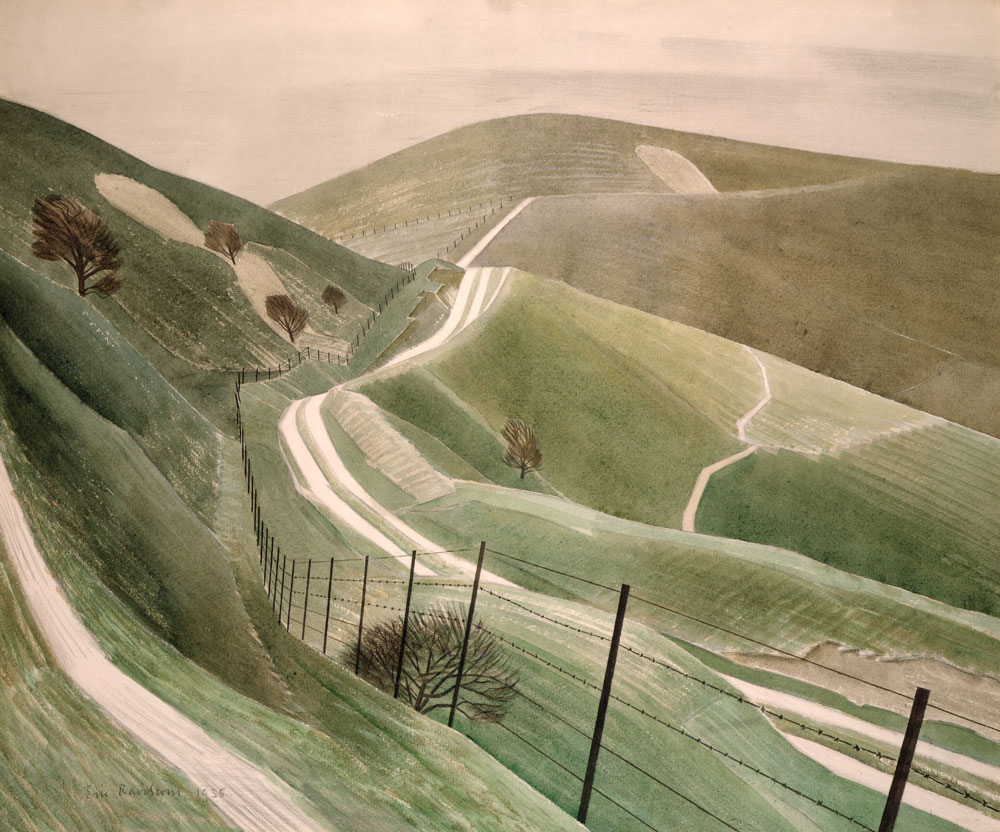
Ravilious was attracted to the light and radiance of the Sussex Downs
Not to forget he was an artist during wartime, this landscape is titled "Shelling by night", 1941

Eric Ravilious (1903—1942), British painter, designer, book illustrator and wood engraver, was inspired by the Sussex Downs of Southern England. His watercolors of the chalk paths and gentle scenery of the area are both serene and slightly discomfiting. There's an echo of the American Regionalism style of the same time, but Ravilious never seems to veer into what I think of as the Americans' fairy tale robustness or swirling animism. His is a quiet mysticism, drawing power from the ancient landscape and particular light.

Ravilious' commercial art on the other hand has a homey cheerfulness. There's a wonderful "Carry On" celebration of Britishness and day-to-day life in his series of storefronts, published as High Street by the Curwen Press. (All 24 lithograph views from High Street can be seen
here.) He did work for Wedgwood with an extremely appealing child-like sensibility. He created wood cut spot illustrations, patterns and icons for the popular "Everyman's Library" imprint and designed for London Transport, among other highly visible —and quotidien—clients.

Ravilious was also an "Official War Artist"* during WWII  and received a commission in the Royal Marines. He was killed in September 1942 on a rescue mission with the Royal Air Force in the North Atlantic off the coast of Iceland.//


An excerpt from a beautiful essay by British essayist and travel writer Robert MacFarlane (which I found here):
Ravilious…Downsman, follower of old paths and tracks, lover of whiteness and of light, and a visionary of the everyday…’The Downs’, he wrote once, ‘ shaped my whole outlook and way of painting because the colour of the landscape was so lovely and the design so beautifully obvious’. ..He made expeditions, slept out and walked for hours following the lines of the Downs, their ridges, rivers and tracks…
The light of the Downs is distinctive for its radiance, possessing as it does the combined pearlescence of chalk, grass blades and a proximate sea. If you have walked on the Downs in high summer or high winter, you will know that Downs’ light also has a peculiar power to flatten out the view – to render scattered objects equidistant.... In these respects the light of the Downs is kindred with another flattening light, the light of the polar regions, which usually falls at a slant and is similarly fine-grained. The light and the path: the flattening (the light) and the beckoning (the path). These are Ravilious’s signature combinations as an artist.
* Did the United States have Official Artists for the war? Any war? It seems so odd— 'go out while people are getting killed and sketch.' But there were official photographers I suppose...

Friday, January 7, 2011

a journey through cloudland*


Note: I think the confluence of weather, time of year, and, especially, the recent Talk of the Town (All Alike by Adam Gopnik) mentioning "Snowflake" Bentley, demands a repost of one of my favorites.


Wilson Alwyn Bentley (February 9, 1865 - December 23, 1931) was born in Jericho, Vermont, in a farmhouse that remained his lifelong home. He was home-schooled and never ventured far from Jericho. At 19, after he combined two treasured presents– a microscope and a bellows camera–Bentley succeeded in capturing the world's first photomicrograph of a snow crystal or snowflake. Working outside, of course, he caught each crystal on a black board and transferred it rapidly to a microscope slide. Doing this he was able to create about 5000 images over the course of his life.

In town, Bentley was considered odd and was known to many neighbors as the "Snowflake Man" because of his quiet demeanor and unusual preoccupation. Although he was a gifted musician– he played piano, organ, clarinet, coronet, and violin, as well as composed music –he devoted himself to his photography
and study of snow.

In 1931 Bentley worked with William J. Humphreys of the U.S. Weather Bureau to publish Snow Crystals, a monograph illustrated with 2,500 photographs. After picking up his copies of the newly published book he walked home in a snowstorm. He died of pneumonia at his farm on December 23.

. . . . .
"The rare delight of seeing for the first time this exquisite lineaments under a microscope, the practical certainty that never again will one be found just like this one... To perpetuate each masterpiece the image of each of each rare gem in the photograph, before its matchless beauty is forever lost (to us) is an experience is so rare so truly delightful that once undergone is never forgotten...Was ever life history written in more dainty hieroglyphics!"– Wilson Alwyn Bentley
. . . . .
Bentley donated his collection of original glass-plate photomicrographs of snow crystals to the Buffalo Museum of Science

*Bentley's description of a snow crystal's trajectory

Thanks to the wondrous
Herbert Pfostl/Blindpony for alerting me to Bentley.

Monday, January 3, 2011

Sexiest Men (no longer) Alive*

Baron von Richthofen, c 1917
80 direct hits. Need I say more?
Early aviator Harry Atwood, c 1910
Not exactly my type but flyboy's got something, too.
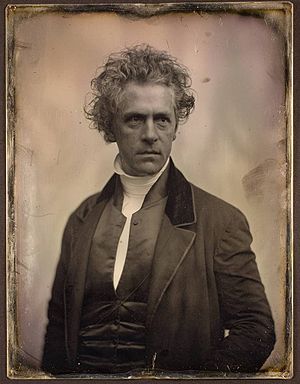
 Reverand Rollin Heber Neale, 1850
That is one nasty preacherman.
William Sydney Mount, 1853
A dastardly lout, a cad, a rogue. Tell me more.
Julius Caesar
Proving that "sexy is ageless" even at 2000+. Vici indeed.
Walter Sickert, about 1918
Walter Sickert is bad news in the best possible way.
Commander in armor, Anthony van Dyck, c. 1625
Long lush hair, beautiful features, armor. Taking command.
Vsevolod Garshin, Ilya Repin, 1884
Ok he seems like a mess but you know you'd want to help him edit his work, get him some new clothes and cook for him.
Adrien Brody would play him in the movie.
Theodore Gericault, Horace Vernet, 1822-23
He painted severed limbs, ship wrecks and the insane and he had tuberculosis. Quite a handful. Then again he looked like this.

Three Men and a Boy, le Nain brothers, 1647-8
Dark, sketchy, satiny long-haired fellows—lets have a beer and discuss.

Young Man at Prayer, Hans Memling, 1487
This young man and Michael Sweerts, below, are vying for Most Sensitive guy
self portrait?, Michael Sweerts, 1656

Portrait of a man against flames, Isaac Oliver, about 1600
The flames, the shirt down to there, the jewelry, this guy is almost too showy for his own good.
Were women throwing their farthingales and drawers at him?
first cousins, the future Tsar Nicholas and King George V
Sporting fellows if ever there were! double date!
Albert of Belgium, about 1917
Impeccably turned out for trench warfare; he can carry me to safety anytime.
Anton Chekhov, 1890s
Weasely, but then again...
a tailor, Giovanni Battista Moroni, 1565-70
Turbulence beneath the calm, no mere shopkeeper, he.
The heart of an artist strains beneath that finicky, micro-slashed doublet.

I see Jeremy Irons in the movie.

William Hogarth, Louis-François Roubiliac, c 1740
Hogarth is more of a runner-up but I do love this bust. 
He's got a laddish humor and pugilistic intensity that wouldnt be out of place in a Guy Ritchie film.
I'd been collecting them on and off, images of men that seem incredibly appealing to me despite the century or two (or several) that might separate us. It started with that photo of Chekhov. Something about the greatcoat and the reed slim cane and that cocky, short man sensibility...  You may remember the electrifying Reverend Neale and the darkly dangerous Mr. William Sydney Mount from my Sartorialist, 1850s Edition post.


This is merely a trifling survey and part of on-going research... A good Regency-era Romantic is a must and I am certainly forgetting some entrancing 18th century fellow so please do let me know who should be on this list. [A Gentlemen's Edition will surely follow in the near future, with a selection of feminine pulchritude of the ages.]

* [with apologies to People Magazine]
Where is William Powell you might ask? Or Kurt Cobain? or any number of too-recent, too-recognized, or too-well-publicized men who could surely otherwise be on a list of Sexiest Dead Men? Well, this is an inexact science so let me know what you think.


PS: Someone asked why I skipped Lord Byron. I have to report that his reputation always seemed more attractive to me than he did.