


 I realize I have no tag or label for this post. Light research based on passing thoughts? Odd "thought clusters"? It was a passage from an article in last week's New Yorker about language and a remote Amazonian tribe that got me thinking about today's note cluster:
 "'Besides,' Gordon said, 'if there was some kind of Appalachian inbreeding or retardation going on, you'd see it in the hairlines, facial features, motor ability.'
Aside from the stunningly un-PC articulation of "Appalachian inbreeding" what struck me was the noting of hairlines. Hairlines? I tried doing a little googling about inbreeding and physical characteristics but didn't come up with much about hairlines. Jawlines, though, is another matter. The Hapsburg jaw, as classically manifested in Phillip IV of Spain, at top, is "mandibular prognathism" or severe lantern jaw and underbite. The Hapsburg dynasty was rife with this and other unfortunate conditions, with Phillip's son Charles II apparently reaching the apotheosis of inbreeding. The effluent of generations of close intra-family marriage (his father and mother were uncle and niece), Charles was impotent, mentally deficient, and unable to chew properly.
...
The famous Goya portrait of the Spanish royal family of 1800 is an excruciatingly unidealized representation of mental sluggishness,
close marriage, political commentary and the just plain fugly.
...
I then revisited old cyber-research haunts at the fascinating and not-as-creepy-as-it-sounds Eugenics Archive (where the next image down is from). The Archive has a terrific educational site that's admirably thorough, beautifully cross-referenced and simply well-done (a quick guide to themes here). A description of the Archive from their site:
Eugenics was, quite literally, an effort to breed better human beings – by encouraging the reproduction of people with "good" genes and discouraging those with "bad" genes. Eugenicists effectively lobbied for social legislation to keep racial and ethnic groups separate, to restrict immigration from southern and eastern Europe, and to sterilize people considered "genetically unfit." Elements of the American eugenics movement were models for the Nazis, whose radical adaptation of eugenics culminated in the Holocaust.We now invite you to experience the unfiltered story of American eugenics – primarily through materials from the Eugenics Record Office at Cold Spring Harbor, which was the center of American eugenics research from 1910-1940.... It is important to remind yourself that the vast majority of eugenics work has been completely discredited. In the final analysis, the eugenic description of human life reflected political and social prejudices, rather than scientific facts.
I'd found the Archive when doing a search about a book I'd read of: "The Jukes; a Study in Crime, Pauperism, Disease, and Heredity," by Richard Dugdale. First published in 1877, it was a study of the lineage of a certain (NY State) family perceived to be mired exclusively in prostitution, thievery and indigence, through several generations. The story continues:
A.H. Estabrook, of the Eugenics Record Office, resurveyed the Jukes (1915) and the Ishmaelites [another pseudonymous family] (1923), and found continued evidence of hereditary feebleminedness and other dysgenic traits. The Jukes and Ishmaelites joined the Kallikaks and Nams as examples of eugenical family studies that were widely taught to social workers and college students during the 1920s and 1930s.
The Archive has riveting field photos, case notes and truly mind-boggling commentary. It also documents Estabrook's other book, "Mongrel Virginians." Enough said.
...
Lastly, I was moved to rediscover the work of Shelby Lee Adams whose photograph of the Napier family, "The Hog Killing" (1990), is shown above. He was born into Appalachia-- Hazard, Kentucky-- and gradually, over 30 years, became known for documenting it on film. I have a book of Adams' work and find it fascinating, but difficult, viewing.
He states:
I have not shied away from what and who has been presented to me. Only an insider could share in this world and I've worked with that knowledge all along. Indeed understanding my place within this culture has been part of my motivation. ...In my opinion this mountain culture should be applauded. Many examples of my work illustrate tolerance of others, resiliency, and acceptance with dignity of conditions others would abhor.
About four years ago I visited the Breakers, the Vanderbilt “cottage” in Newport, RI. It was explained that in restoring the building several elaborate fabrics and wallpapers had to be recreated from original 100+year-old damaged remnants. Scalamandre, a name I was vaguely familiar with, had undertaken analysis of fiber content, color and patterning and then reproduced these fine specimens of Gilded Age excess. With a little research I discovered that company excelled at small-run bespoke fabrics and high-end hand-screened wallcoverings of up to sixteen colors. Most importantly, the 75-year-old concern that had created custom silks for the White House, fringe for Big Bird, and tassels for the Old Merchant’s House museum was also responsible for the brilliantly zany zebra wallpaper* in the Red Sauce Italian landmark, Gino’s of Lexington Avenue. And at the time (this was late 2003) they were taking shipments of sticky, raw silk to finished dyed and woven fabric all under one roof—in a mill in Long Island City. I was astounded. Someone still did this? In New York City, no less?
I then made a determined effort to get a look inside the place…  Long Island City**, a former industrial center, home to stapler factories, printing plants and shellac distributors, is now in the process of being radically transformed. At the time of my visit, the Scalamandre mill was probably among the last light industrial holdouts.
 I found it on a non-descript and fairly bleak street: a relatively small 19th-century brick building with strangely beautiful skylit spaces and worn plank floors.
 It was an idiosyncratic manufactory mixing pedal-powered wooden looms, Eisenhower-era machinery, handwork, and modern computer-run technology. I was fortunate to get a quick tour of the mill that day, learning a little about warps, swifts and loom cards in the process. Very shortly thereafter Scalamandre announced they were moving out-of-state, and selling the building.
  I later read they were having a kind of fire sale—a dream flea market of antiquated bits and pieces, fabrics and trimmings, emptying the place of its arcane and –to the outsider—inscrutable devices. I was so emotional about that building (true)—I couldn’t even bring myself to go.

An important part of Scalamandre’s work is historical research and reproduction. In an on site studio in that mill they analyzed samples soiled by coal and wood smoke, faded by sunlight, or brittle with age. Probing hidden seams for color and poring over contemporary publications for design documentation they resuscitated vibrant color schemes and completely reconstituted complex repeating patterns. I loved the notion of forensic design technology, a sort of CSI: Decorative Arts Unit.
... ...
 *The paper shows up, charmingly, in The Royal Tenenbaums, and, rather less interestingly, in Kate Spade’s bathroom.
**The 7 train’s elevated path through LIC into Queens, with its magnificent sight lines to Midtown Manhattan, is rather exciting and should probably be landmarked.
Images from top: the view from the 7 train; "the Old Mill"; hand-screening wallpaper, with the zebras in the background; swatches, and spools set up for weaving stripes; looms; some of the afore-mentioned Eisenhower-era machinery: a dying vat; quality inspection; patriotic passementerie; antique spinner, and spool boxes; classic zebra wallpaper at Gino's from the New York Times


 Top: April 13, 1929, Eduardo Garcia Benito; January 2007; 2nd row: March 1, 1949, Marcel Vertes; October 1, 1941, Carl Erickson; December 15, 1936, Jean Pages; 3rd row: December 15, 1932 Erickson; October 1, 1935, Benito; July 15, 1939, Erickson; Bottom: December 1, 1938, Benito
I stumbled on a limited but truly enthralling collection of Vogue covers in the "art archive"— a merchandising web portal– of Condé Nast. Images available are heavy on the 1920s and 30s, with nothing past the late 1950s, but the offerings are well worth a detour over.
I was quite familiar with the (beautiful) covers of the Twenties. I had studied fashion for a bit, interned briefly at the Met's Costume Institute, and I still have a few books of fashion art. However, nothing prepared me for the brilliant, daring, effortlessly vibrant art of the 30s and 40s covers. The covers in the second row above, especially, are amazingly risky: The strange spiky bird for "Spring," autumnal passing legs--shod in non-descript day wear no less!, and what looks like a pre-saging of Pearl Harbor but is in fact meant to evoke a cruise ship steaming its way toward glamorous shores for the "Resort Issue." Unusual vantage points, edgy color choices (brown! with fluorescent pink!) and not a celebrity in the bunch. How dull and and flaccid that Angelina Jolie cover is--merely a vehicle for the headline text and a wrapper for the ads. A predictable end product of demographic surveys, publicity campaigning, and marketing pronouncements.
I virtually never buy "women's" magazines anymore and I probably haven't picked up Vogue since the nineties. I do remember illustrators having quite a high profile in the eighties: Mats, Stavrinos, Antonio, Viramontes. What is happening today? And the oddly alienating and irrelevant drawings used in newspaper advertising for stores like Macy's and Lord & Taylor until, what 10 years ago? are they still being used? That was like the dry husk of fashion illustration. What I wonder is: Did true fashion illustration die without my noticing?
 If I come across a particularly vivid old photograph, especially if it's a New York street scene, I find it thrilling--as though I've uncovered a bit of treasure. I find I can pore over it so intently, get drawn in so completely, that, if I allow myself, I can almost —almost—fantasize being in the image. It's sort of embarrassing.
To the extent that a photographic image, the rectangle, is a metaphorical window, its frame blocks the rest of the world that continues just beyond those edges. The "glass" is immovable, the "window" shut. I wonder, though, about what is to the left or the right. Or what connection there might be, in that photo of yesterday, to what I know today. The photographs here are part of a series of modern reprints I found in a drawer at Bowne. I believe they are a set of tax ID photographs taken in January and February of 1928 of the South Street area – in other words scenes right around Bowne. It shouldn't have been a surprise to see that the relatively tidy retail mall of today was rough, ragged-edged and tired-looking in the light of that day 79 years ago.


The dirtiness of the street, the worn and dusty clothes on the worker in the cap (click the details above for very large view), a horse drinking from a stone watering trough, the bundles of rags and paper scraps: the 19th century is palpable. Here, "the modern" is foreign. Seventeen years after these images were taken, Joseph Mitchell described these streets in Up in the Old Hotel:
I could distinguish the reek of the ancient fish and oyster houses, and the exhalations of the harbor. And I could distinguish the smell of tar, a smell that came from an attic on South Street, the net loft of a fishing-boat supply house, where trawler nets that have been dipped in tar vats are hung beside open windows to drain and dry. And I could distinguish the oak woody smell of smoke from the stack of a loft on Beekman street in which finnan haddies are cured; the furnace of this loft burns white oak and hickory shavings and sawdust. And tangled in these smells were still other smells— the acrid smoke from the stacks of the row of coffee-roasting plants on Front Street, and the pungent smoke from the stack of the Purity Spice Mill on Dover Street, and the smell of rawhides from The Swamp, the tannery district, which adjoins the market on the north.
After rereading more of the book, I discovered that the building above, left, in my photograph, 92 South Street, is the "Old Hotel." By the time Mitchell hung around the docks, the restaurant at 92 was called Sloppy Louie's (It was still John Barbagelata's place in 1928) and the locals stopped in for breakfast specialties like a shad-roe omelet or sea scallops and bacon. (The South Street Seaport of today does not say "sea" or "port" or "shad-roe" or anything marine to me at all, unfortunately...)
The Romantic-era philosopher and essayist Johann Gottfried von Herder created the term Einfühlung, which is often translated as "empathy." Not that I know very much about Herder (as I've said before I know a little about a lot of things, just enough to be annoying) but when I first came across this word I recognized it and identified with it as putting a name to a complicated, elusive and for me, enjoyable, state of mind.
... a "feeling into," [Einfuhlung is] projecting one’s mind into the object of one’s contemplation, of seeing and thinking and experiencing from its perspective and so coming to understand it better, of turning it into a subject and oneself into the object of its gaze.– Robert Daly (SUNY Buffalo)
Herder's intent may be different from my reading of it, but I'm satisfied to have it defined in my own mind.
When I look at these photographs above, I think about being on those streets with horse-drawn wagons and automobiles and the last shadows of the 19th century, and then I think of Flappers and the Chrysler building, Hollywood and Art Deco, and I can almost see it happening at the same time, just beyond the frame.

This isn't an actual photo of my old television, but almost: the rounded corners, the double- decker dials, the on/off/volume knob are all spot-on. It had a small sticker in back that said "manufactured: March, 1987" and it might possibly have been one of the last appliances made with the gesture of faux walnut cabinetry. Over the years I spray painted the cabinet, first gold metallic, more recently white. People would say, "Wow, a B/W tv?!" but it was actually a full fifteen inches of glorious cathode ray color. That recent glossy white coat actually gave it an almost Verner Pantonesque flair, like set decoration for a *Wallpaper shoot. I never really had any problem with it, or with reception (it had a rabbit ears antenna) and the image was just fine until the very end. I finally replaced it, with a new flat screen, shortly after its 19th birthday.
In researching for my next tv purchase I had been told that new(er) television sets were more "sensitive." Sleek, sliver-like, highly attuned, they picked up ambient interference, electromagnetic fluctuations and the like that the old(er) sets, stolid and workmanlike, did not. No longer could I just plug the thing into the wall and go-- I would need cable. I was enabling a neurasthenic intelligentsia to take over from the lumpen proletariat.
{eight ensuing months}
As I began this post, a gossamer sprinkling of snow glittered in the street lights outside, but my flat screen remains dark. The cable box flashes an insistent 7:15, but it is after 9. My friends in cable repair are coming to visit again! But I need to wait 3 days.
*zugzwang-- (from chess) A position where one is forced to make an undesirable move.
*schlimmbesserung - literally means, "an improvement which makes things worse."
 For a while now I've been mulling over the hollowness of "You"-- the purported prime mover in the consumer chain. Design your own personal sneaker, Hummer, pizza. Express your personality through the oxymoronic doublespeak of "mass customization." The escalating illusion is that now, with technology at one's fingertips, the power is in your hands. As with niche marketing, innovations with just your slice of demographic in mind, one is told many times over, "you deserve it." You're so busy/ important/overworked/ worthy, you deserve 500 channels of 24-hr HD sports (or whatever), you deserve soup in a go-cup, a good night's sleep with AmbienCR. Here's a fat-free fudge-dipped caramel bite with extra calcium created expressly for your over-40 bones. Coach or L.L. Bean in your Lincoln Navigator? Your choice! This proliferation of specious choice-- the so-called American ethos of individualism ("freedom") distorted through a lens of consumption. All of this disingenuous catering (pandering?) to "you." And then last week Time made "you" the Person of the Year in one of the most oleaginous essays I've read recently:
And we didn't just watch, we also worked. Like crazy. We made Facebook profiles and Second Life avatars and reviewed books at Amazon and recorded podcasts. We blogged about our candidates losing and wrote songs about getting dumped. We camcordered bombing runs and built open-source software. ...Who has that time and that energy and that passion? The answer is, you do. And for seizing the reins of the global media, for founding and framing the new digital democracy, for working for nothing and beating the pros at their own game, TIME's Person of the Year for 2006 is you.
What about me? Despite both designations having to do with the individual, presumed solipsism, and implied atomization, the "Me" of the Me Generation (I believe it was Tom Wolfe who christened the 70s the Me Decade, with "generation" being an extrapolation from that.) strikes me as a different concept. At its most elementary level, the term is subjective: me, I. And I read the term, at very least, as active --seeking out self-definition, though not necessarily through consumption. This "You" moment conveys an object observed and defined by others: what you buy, what you own, your 'audience.' The you as consumer defined by age/income/race/ demographic...
---
I only just recently saw the Frontline show "The Persuaders" on the web, although the episode is more than 2 years old. It is a disturbing and utterly fascinating overview of the current culture of marketing and advertising and its societal influences. The web site for the episode is dense with interviews, transcripts, commentary--it is a must. Someone there (cant remember which person sums it up) distilled for me what had been ill-defined complaints and ravings: the danger of an atomized populace in a completely immersive, consumer-driven society is that there is no longer a recognition of "the common good," or civic duty; democracy itself comes apart. Media critic Mark Crispin Miller (whom I had not heard of before) delivers some of the most devastating commentary. Consumers are feeders. All consumers do is consume. ...They're being manipulated to think only about the grass that they're chewing and nothing else, and manipulated into thinking about ways to get more grass. They're not operating on a sufficiently high level to participate in a democracy…
---
So the Burger King "have it your way" campaign of circa 1974 (?) was a brilliant precursor to the mass customization model...
 I love diners. They are one of the truly great things in this country. For all my anglophilia, British caffs don't even come close. They are, to be fair, fascinating in their own right but exist in a wholly different realm-- one that conjures pre-'Cool Britannia' insular Britain, resignation and strange notions of comfort food borne of privation (see: beans on toast). Perhaps I'd put them in the same continuum as the urban coffee shop but way at the other end. Very generally speaking American diners are about abundance.
People fetishize the iconic chrome diner (one of my sentimental favorites: the Cutchogue) unfortunately to the exclusion of the many other incarnations and details of diners of all stripes. The comically grandiose Outer Borough variety (I come at this from an acutely NYC-centric perspective) in stucco and smoked mirror, are usually free-standing buildings, and are remodeled and updated periodically. You will find (9.5 times out of 10) Greek souvenir kitsch, a lively atmosphere, voluminous menus, a motorized rotating dessert display, and if you're very lucky, paper placemats of cocktail recipes that include things like Sprite. In the city, there is the corner coffee shop. It is increasingly rare to find one that retains a Hopperesque urban melancholy but I still try, having many a tuna melt around town in the process. (Andrew's Coffee Shop, Madison and 33rd, is not very Hopperesque, but it does make the best tuna melt I've encountered yet, above, the secret being the grilled toast.) Another Andrew's that closed a year or two ago on Fifth Avenue near 20th Street, was a bit closer to capturing that sensibility though not literally. Bright and beige and open-planned in a quietly 1960s way, it had an extended horseshoe counter and stools where a regular scattering of patrons was always alone together. Waitresses offered newspapers from behind the counter to those who felt stranded, not knowing what to do with themselves, or where to look, while they ate.
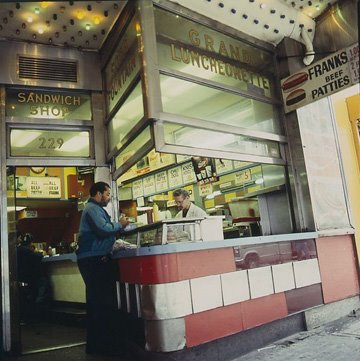 A word about terminology: luncheonette, which I find to be more a written, rather than spoken, word, is a small diner: a counter with stools and maybe one row of tables or booths. Eisenberg's sandwich shop, an interesting and enigmatic hold out on Fifth Avenue, is a luncheonette. The evocatively shabby Grand Luncheonette, left, wedged under a decaying theater marquee on 42nd Street, was in fact one of the last of the dying breed of lunch counter, consisting of only the open kitchen and serving counter with stools. (Photo c. 1997 by Robert Wright.) There used to be a large Woolworth's on east 14th street that closed about the same time as the Grand and it had an iconic double-horseshoe lunch counter complete with pies on stands under glass domes. Sort of like a real-life Wayne Thiebaud.
I imagine New York City of the 1950s filled with lunch counters.
One of the best incarnations of all however is the random road side find--chrome or otherwise-- preferably with some mysteriously named local specialty...


 I realize I have no tag or label for this post. Light research based on passing thoughts? Odd "thought clusters"? It was a passage from an article in last week's New Yorker about language and a remote Amazonian tribe that got me thinking about today's note cluster:


