Monday, October 11, 2010

Alexander Anderson: master engraver, nice guy


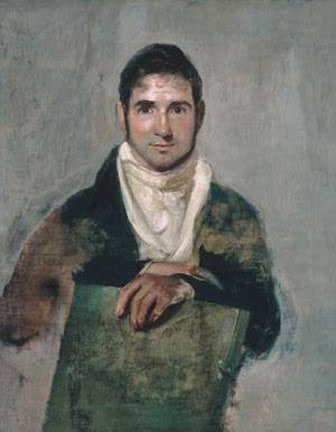
Alexander Anderson, 1818 by John Wesley Jarvis. Doesn't he just look like a sensitive guy in this portrait?


I am particularly fond of Anderson's plain old commercial work and lettering.
Also, winsome yet unsettling tailpieces and vignettes like the two immediately above, and children's primers (like "dunce" above)
influenced Edward Gorey's style of illustration.

In rooting around today, attempting to do some research on engraving for a new book, I came across the massive and awe-inspiring collection of work by Alexander Anderson. Anderson (1775-1870) is considered one of America’s earliest and finest wood-engravers (completely different from the steel bank note engraving I was looking for and thus, of course, I spent my entire day perusing unrelated materials...), similar in style and artistry to the great (earlier) British engraver Thomas Bewick.

Born in New York City to Scots immigrant parents Anderson was completely self-taught. In his young adulthood he made and sold engravings in his spare time to help finance his way through the Columbia medical program. He married early, and practiced medicine only briefly, giving it up and turning to engraving full time when his wife and infant son died in a yellow fever epidemic in 1798. He remarried and went on to have six children. It is through his family that some of his original work --proof scrap books and original artwork, some tools--was saved and handed down (evidently with touching marginalia like "I saw Grandpa make this, Spring 18xx, when I was 10"), eventually residing in the New-York Historical Society.


True to form, the Historical Society has nothing online and the items are likely collecting dust in their acid-free, archival sarcophagi.
The New York Public Library, on the other hand, has a truly magnificent and overwhelming digital archive of sixteen of Anderson's scrapbooks, containing close to 10,000 wood-engraving proofs of his work for books and journals but also for business letterheads and other commercial ephemera. He drew everything: anatomical illustrations, children's primers, Egyptian scenes, steamships, slave scenes, polar bears, printing presses, lottery tickets, domestic parables, factories, famous men in history, scenes from Shakespeare, and labels for toothpaste. Anderson's work spans an incredible seventy years— he made his last engraving in 1868, at 93 years of age— and it's amazing to see the stylistic changes in dress, transportation and lettering styles.

updated:
I've posted a few of his simple vignettes and commercial lettering only since I find those most evident of hand craft and the most poignant, really. Everything he did seems to have an effortless charm and impeccable execution —even lowly commercial work. All this craft and beauty for utterly inconsequential things like pins; an artisan of the throw-away.

Tuesday, October 5, 2010

A man named "Named", and other names...*

above, two sources of names for the Lexicon of Greek Personal Names. The example directly above is a gravestone for "Zosime, daughter of Herakleon", from Syria, late 1st century B.C. The hands on the stele symbolize her relatives' vow to avenge her death which was apparently not a natural one.
First, if you don't regularly visit Arts & Letters Daily you ought to. Its like a cultured news aggregate: The front page has regularly updated links and brief teasers for essays, reviews, investigative journalism and opinion pieces from a varied and international roster of publications and sites.

And so it was on one of my perusals of A&LD that I came across a delightful review of "A Lexicon of Greek Personal Names, Vol. V. A Coastal Asia Minor: Pontos to Ionia edited by T. Corsten" in the London Review of Books. The Lexicon project (it's a site as well as publication):
traces every bearer of every name, drawing on a huge variety of evidence, from personal tombstones, dedications, works of art, to civic decrees, treaties, citizen-lists etc., as well as literature, artefacts, graffiti etc.
A staggering thought: someone compiled a register of all ancient Greek names that were permanently recorded on "paper" or stone, from the age of Homer to early Byzantium.

And God love the British, the review of the book runs to approximately 5600 words. Doesn't sound very promising ... But
in fact the reviewer James Davidson, an academic who makes something of a specialty of writing about the odder corners of ancient Greece, offers up a witty and expansive background essay of names and naming in England before moving on to the Greeks.

I have always been intrigued by fashions in naming (whither Dorcas and Edna?) and oddities of conception (see Puritan names below) so I found Davidson's essay extremely informative and fun. He notes the liberality and inventiveness of naming in English-speaking countries. Moon Unit Zappa, Trig and Track Palin and assorted Hennessys, Apples and Prince Michaels et al. are "self-conscious expression of an assumed freedom to name children whatever parents want." By way of contrast he cites an Italian couple wanting to name their child Venerdì (Friday). A judge, having refused to allow it, renamed the kid Gregorio. Until recently some other countries, notably Germany, Sweden and Denmark, had maintained lists of approved names!

He goes on to relate the dramatic upheaval in English naming after the Norman Conquest. With the ensuing influx of French and other Romance languages native names such as Aethelwulf, Aethelflaed, Frithuswith, Ealdred go the way of Grendel, being rapidly
replaced with Geoffreys, Henrys and Eleanors. Davidson uses this episode to explain label names versus transparent names— terms I'd never heard before. A label name would be, for example, Geoffrey (or Geoffroi). It doesn't give you much information to go on—especially if you don't speak French and not even the sounds are familiar. To a post-Conquest Briton Geoffrey is opaque. By contrast the native speakers used transparent monikers–which literally meant something to native ears–like Aethelflaed, ‘Noble Beauty,’ or Aethelraed, ‘Noble Counsel.'

In this, the Anglo-Saxons were very much like the Greeks whose names in large part
mean something. This made me think of Native American names and the strange convention we have of translating some: Tashunka Witko is known to us as ‘Crazy Horse’, Tatanka Iyotake is ‘Sitting Bull’—but leaving others to be merely transcribed: Sacagawea or absurdly, even Tonto. The translation into everyday English words makes the names paradoxically alien and somewhat ridiculous. Anglo-Saxon and Native American names are transparent and Greek ones are similarly transparent in the native language. If we translated the ancient Greek names as we do Indians' we'd come across 'He Who Loves Horses’ (Philip), ‘Masters (with) Horses’ (Hippocrates), ‘Flat-Nose’ (Simon), ‘Stocky’ or 'Broad' (Plato), ‘Famed as Wise’ (Sophocles) and Peace (Irene).
Greeks seem to have taken pleasure in making up names:
Epic poetry is full of names, a fair number of which must have been made up by the poet... In Theogony Hesiod names 50 nereids in a virtuoso performance of nearly abstract prosody: Sandy, and charming Salty, and lovely Promontoria, Goodmooringia, Welcome-Wave, Current-Carried etc.
How different would our conception of Plato be if he'd come down to us as "Stocky"? //


Not discussed in Davidson's review is the incredible panoply of names in America starting with the extraordinary and singular inclinations of the Puritans. Religious Dissenters (like those who emigrated to New England) took to Old Testament names (whence your Hezekiahs and Mehitabels) or they made them up as they went along (keeping God in mind at all times, of course).
If you feel up to wading through it, the jocular Curiosities of Puritan Nomenclature (1884) by Charles Waring Endell Bardsley is the place to find out about all those Temperances, Fear-nots, Hope-stills and Preserveds (see above).

The index of names is amazing.


* From the
Lexicon of Greek Personal Names: Onomastos ("Named") was a man from Smyrna in modern day Turkey.

Monday, August 16, 2010

Consider the Cassowary

cassowary skeleton, Thomas Smillie, c. 1906
Jean-Baptiste Oudry, Cassowary, 1745
Double-Wattled Cassowary

If I were a cassowary
Far away in Timbuctoo
I would eat a missionary
Hat and boots and hymn-book too
British children's rhyme, c. 1880
• • •   • • •    • • •
What made me start thinking about this bird? All day I've been caught up in its outlandish magnificence. 

The cassowary, living paleo-avian incarnation, avatar of dinosaurs, is part of the ratite group, one of the oldest evolutionary branches of birds with living descendants. Originating in Gondwana— the Southern super-continent of approximately 550–500 million years ago— ratites now comprise a few flightless birds sprinkled across the southern hemisphere, the cassowary specifically, is native to Australasia. The name is a corruption of the Malay suwari or kesuari which seem to refer to a tree as well as the bird.

Standing more than 5 feet tall and weighing up to 130 pounds the bird has a long, usually black, hair-like coat* with head and neck presenting astonishing swaths of blue, yellow, red and orange. Also brightly colored are the pendulous and nearly obscene wattles characteristic of two of the three species. But one of its most distinctive features is the horny protrusion or casque that crowns the head.

The cassowary figures in Melanesian art and spirituality— particularly as a fertility symbol and powerful female creator figure. Some tribes believe the birds are reincarnations of female ancestors. This seems to be an intriguing and empathetic reading of the bird's social habits. Author Bruce Bagemihl elaborates:
The cassowary is considered by many New Guinean peoples to be an androgynous or gender-mixing creature. This bird possesses many of the physical attributes of strength, audacity, and ferocity traditionally considered masculine. Yet numerous New Guinean cultures also consider the cassowary to be an all-female species (or each bird to be simultaneously male and female), and often associate them with culturally feminine elements....The androgynous cassowary is also considered to be an intermediary of sorts, between the animal and human worlds.
This "androgyny" becomes more believable in knowing that the male is smaller than the female, and the male alone incubates the eggs and stays with the young until they are about nine months old. 

The birds can run thirty miles an hour, and can jump five feet into the air simultaneously kicking a foot dressed with a 4-inch talon. (So is it more likely to be a female out creating havoc? As the males are at home taking care of the kids?) A swift downward slash of the foot can easily do mortal damage. One nature website notes: "[the cassowary's] inclusion in the British Dangerous Wild Animals Act (1976) is wholely justified and their potential to injure, maim and even kill should never be underestimated."

I love this bird.
* Now I am in no way advocating hunting but it struck me that the cassowary would make a particularly amazing chubby, with the horn as a closure adding a Rick Owens-ish edge.
1940s chubby

Tuesday, August 3, 2010

camp: better late than never

A few days ago I came back from a week in Shelter Island. I've been going out since the late 90s— a week or weekend, here and there-- and after an unintentional hiatus of 3 years I returned to the place with quiet exhilaration. I had fully intended on updating the blog from out there, but I caught up on my erstwhile once-a-year bike rides instead.

Having grown up in New York City (well, Queens) with neither a beach nor country house in the family, and no camp experience whatsoever, I'm now living out my childhood exploratory fantasies in sporadic getaway parcels. I have ice cream with impunity and grill corn and drink wine every night. Its camp without the mean girls (usually).

I'm not a swimmer or a surfer — and Shelter Island's shoreline is pretty meager anyway—so any empty stretch of sand and water is fine for a dipper like me. The island itself is lush and green with gentle hills, horses, deer and lots of cottontail rabbits: rather like a Hudson Valley village, with beaches. Oh and there are antique stores, too. (see purchase, above)

I took some nighttime walks and tried photographing the stars. I guess it says something about me that my favorite photos of this summer beach excursion are these below: taken at about 10pm, a few days past a full moon. My fake Steichens and fake Hidos.

Friday, July 2, 2010

ancient memories


A couple of days ago I visited the venerable Museum of Natural History. Caught between appointments with too much time to kill, I decided to see the Silk Road exhibition. It had quite a bit of really provocative information and was quite a show-stopper of an installation—I may eventually write something on it here, but this post isnt about that. It's about a somewhat sidelined hallway mural on the fourth floor. In a niche at the end of one of the dinosaur galleries is the 25 foot tall Flying Reptiles by Constantin Astori (1889-1975). A Russian artist who came to New York in 1923, Astori worked for the Smithsonian and the Cooper Hewitt as a restorer. The American Museum of Natural History commissioned him to paint a mural in 1940, and Flying Reptiles is signed 1942.


Oddly, as soon as I saw it, it was familiar to me from a very early, distant memory, although I had no specific childhood recollection of it. Perhaps it was reproduced in one of my books on dinosaurs (an avid interest circa ages 5 through 10)? In doing a little armchair research I rediscovered another very familiar mural: the magnificent Age of Reptiles by Rudolph Zallinger. (Interestingly, like Astori, Zallinger was a Russian, from Siberia). Age of Reptiles is a massive 110 foot long fresco panorama completed in 1947 at the Yale Peabody Museum of Natural History. (I'm ashamed to say in my 4 years in New Haven I never did get over to the Peabody—I intend to go in August.) The mural was reproduced in several dinosaur books in the late 60s/ early 70s and that's how I know it.
Age of Reptiles (detail) Rudolph Zallinger
Zallinger was by far the better draftsman but there is something I love about Astori's Flying Reptiles. Somehow, his mural conveys "Lair of the Zorgons on planet Rilor" in a loopy science fiction sort of way, rather than "speculative view of life on prehistoric earth." Its a bit humorous (see the pterosaur antics in the details above) and I half expect to see a Maxfield Parrish nymph perched one of the rocks, nevertheless I'm simply drawn into that fabulous compositional spiral toward an ancient technicolor sunset.

Sunday, June 20, 2010

the Burns Method Part II: Death Avenue and Martha Stewart

I first came across this astonishing photo of West 26th street and Eleventh Avenue on Shorpy but it's originally from the George Grantham Bain Collection of the Library of Congress. This is probably one of the richest images I've ever seen—it verges on the surreal in its disparate simultaneities. Surely GG Bain didnt see, at the time of clicking the shutter, all the separate stories he was recording.
Journeying around the image—something I think of as the Ken Burns method— its fascinating to see the details of that moment. [NOTE 7-18: I shouldn't be surprised there's a Wikipedia entry about the "Ken Burns Effect"— I just cant believe I didnt know about it or the Apple reference.]
There's the coal bin on the front of the train engine, the man making his way on crutches, the spindly "ice" cart. From the camera's vantage point (and ours) the young boys and chalk drawings on the sidewalk could have been captured by Kertesz. Notice the "flagman" riding in front of the train—here a barrel cart has gotten in between. Boys on horseback, called "West Side cowboys," had to carry a red flag to warn of the approach, at six miles an hour, of each locomotive.
New York Central's freight line had run along Tenth and Eleventh Avenues since 1849. Known as "Death Avenue" for the number of pedestrians killed by the mix of railroad and street life, the name was used collectively for both streets. Statistics vary; one study recorded 21 deaths on Tenth and Eleventh from July of 1907 to July of 1910. Somehow the flagmen didnt seem to make walking along the avenue much safer. A New York Times notice from November, 1911, about the year of this photo, announced:
"Another 'Death Avenue' suit was filed yesterday [by the brother of the victim]... Cyrus J Burby was crossing Tenth Avenue, the complaint states, when his foot became wedged between the track and the sidewalk. Before he could extricate himself a train bore down on him without warning and he was decapitated."
In 1929 the City and State of New York and the New York Central Railroad agreed on the West Side Improvement Project, which would replace "Death Avenue" with a seemingly futuristic elevated line that entered warehouses on their upper floors. 
By 1931 the entire block in this image— the west side of Eleventh Avenue, 26th to 27th streets— had become the magnificent Starrett-Lehigh Building. The Lehigh Valley railroad had retained the ground floor as a vast freight yard, and the 19-story, 1.8 million-square-foot building, with its three gigantic elevators to lift and lower trucks, was put up directly above it. (Today the axle grease has been wiped away and Comme des Garcons, Hugo Boss, and Martha Stewart are among the tenants)
The High Line, as the new elevated freight line was called, opened to trains in 1934 and was used until the early 1980s. Saved from demolition by a grassroots movement in the early 2000s, a portion of the High Line is now a park that is so exquisite, so unbelievably well done, it's hard to believe it got built in New York. In my opinion, it is one of the triumphs of this city.