Monday, May 24, 2010

Afterglow

Sunset and afterglow, November, 1883
November 9, 1883
Sunset, May 10, 1884
Amber afterglow with crepuscular rays, September, 1885
Sustained light after sunset, July 12, 1886
Sunset and noctilucent cloud, July 6, 1885

I mentioned the British artist William Ascroft (1832-1914) at the end of the last post about volcanoes. I thought his remarkable, almost eerie series of sketches documenting the atmospheric effects of Krakatoa's eruption upon London's sunsets warranted a bit more attention. In the years after the 1883 explosion, Ascroft's rapidly drawn sketches recorded details that would have been otherwise ephemeral or merely described before the invention of color photography.
In a thoughtful April 15th New York Times Op Ed piece that I only just now saw, Simon Winchester, author of “Krakatoa: The Day the World Exploded,” creates a wonderful image of Ascroft laboring to capture the "magic" in the sky:
An obscure Londoner named William Ascroft, astonished by the nightly light show along the Thames, turned out a watercolor [sic, they appear to all be pastels, not watercolors] every 10 minutes, night after night, working like a human camera. More than 500 Krakatoa paintings survive him. “Blood afterglow,” he jotted down on one canvas, noting the magic done by refractive crystals of dust; “Amber afterglow,” on another.
When The Eruption of Krakatoa, and Subsequent Phenomena, Report of the Krakatoa Committee of the Royal Society was printed in 1888, several chromolithographic prints of Ascroft's sunsets were painstakingly reproduced and included, having been deemed to have exceptional scientific import. Printed to the artist’s directions by the Lithographic Department of the Cambridge Scientific Instrument Company, the job required ten different 'stones' or printing plates.

As an aside, I found this photograph of "noctilucent clouds" over Hungary taken in 2006. Originally recognized as a polar atmospheric occurance, the clouds have now been spotted in much lower latitudes in recent years. It is thought that global climate change may be the cause.

Thursday, May 20, 2010

Volcano notes

April 17, 2010. (REUTERS/Ingolfur Juliusson)
April 17 and April 19, 2010. Örvar Atli Þorgeirsson

I had a dream, which was not all a dream.
The bright sun was extinguished, and the stars
Did wander darkling in the eternal space,
Rayless, and pathless, and the icy earth
Swung blind and blackening in the moonless air;
Morn came and went -and came, and brought no day,
....
....
Ships sailorless lay rotting on the sea,
And their masts fell down piecemeal; as they dropped
They slept on the abyss without a surge—
The waves were dead; the tides were in their grave,
The Moon, their mistress, had expired before;
The winds were withered in the stagnant air,
And the clouds perished! Darkness had no need
Of aid from them—She was the Universe!

In July of 1816, Byron, Percy Shelley, Mary Wollstonecraft Godwin, Mary's stepsister Claire, and Byron's physician, John Polidori, were spending their days indoors at the Diodati Villa, on a sojourn in Geneva, Switzerland. They were taking shelter from the inexplicable cold, "incessant rain" and mysterious fogs. "There was a celebrated dark day," Byron recalled, "on which the fowls went to roost at noon, and the candles were lighted as at midnight." Held captive by the weather, Mary drafted what would become her novel, Frankenstein, Dr. Polidori wrote The Vampyre, and Byron wrote "Darkness" (excerpt above), their creative energies sympathetic with the brooding elements.

Strange weather, lengthy periods of darkness and record-cold temperatures swept across Europe and North America that summer. Prolonged, brilliant sunsets and twilights were frequently seen. On June 6, snow fell in Albany, New York, and Dennysville, Maine. Nearly a foot of snow fell in Quebec City. Lake and river ice were reported as far south as Pennsylvania.The resulting crop failures and livestock loss forced up prices, created panic and produced famine in many parts of the world. Some historians point to the weather conditions in New York and the Northeast of 1816 and '17 as spurring an early westward migration.

1816, The Year Without Summer or the Poverty Year, it was later determined, was the result of a volcano, erupting the previous year, thousands of miles away.


On Wednesday, April 10, 1815, Mount Tambora, a volcano in the Dutch East Indies, thought to have been dormant for 5,000 years, had begun a series of eruptions. On April 15th the final and largest blast spewed sulphur dioxide nearly 27 miles into the stratosphere. The finer ash particles stayed in the atmosphere up to a few years causing global climate changes. The pyroclastic flow killed over 10,000 local people immediately and another 70,000 or more were killed on neighboring islands in the aftermath of tsunamis, ash blanketing and the resulting agricultural devastation. Tambora was the largest volcanic eruption in at least 1,600 years— ten times the size of Mt. Vesuvius. 

Decades later John Ruskin gave a lecture at the London Institute on another meteorological anomaly. In a semi-apocalyptic conflation of atmospheric and psychological disturbance, Ruskin railed about ominous clouds:
For the sky is covered with gray cloud;—not rain-cloud, but a dry black veil, which no ray of sunshine can pierce; partly diffused in mist, feeble mist, enough to make distant objects unintelligible, yet without any substance, or wreathing, or color of its own. And everywhere the leaves of the trees are shaking fitfully, as they do before a thunder-storm; only not violently, but enough to show the passing to and fro of a strange, bitter, blighting wind.... It is a wind of darkness...It is a malignant quality of wind, unconnected with any one quarter of the compass; it blows indifferently from all, attaching its own bitterness and malice to the worst characters of the proper winds of each quarter....
This was a year after the famous 1883 Krakatoa eruption. //

Following the August 27th Krakatoa eruption, artist William Ascroft documented eerily brilliant sunsets and other optical phenomena over England, attributed to the volcano's after-effects, until 1886. For a selection of his uncanny sketches, see the Science and Society Picture Library/
Twilight and after glow effects at Chelsea, London, Nov. 26, 1883

Saturday, May 8, 2010

Shadows in living color

Images from top: Pearl Street and Peck Slip, October 7, 1942
Drink cart near the Battery, October, 1942
Wartime salvage, October 4, 1942
58 Mulberry Street
South East corner of First Street and the Bowery (and the same corner today in a desultory view from Google maps)
Charles Weever Cushman (1896–1972), dedicated amateur photographer, bequeathed approximately 14,500 Kodachrome color slides to his alma mater, Indiana University. The resulting Charles W. Cushman Photograph Collection of the Indiana University Archives is a meticulously documented online repository (you can read the grant proposal, peruse online scans of Cushman's notebooks, find out about Charles, or read about the color restoration process).
Amassed by Cushman during a thirty-two year period from 1938 to 1969, the slides document a dizzying array of subjects, in part: fires, floods, train wrecks, train yards, harbors, street vendors, street scenes, churches, synagogues, saloons, advertisements, the steel industry, mining, ghost towns, farms, urban slums, mule auctions, and the filming of B movies. What particularly interested me were the shots of New York, many of which are from the early forties. Nearly all the images are preserved in uncanny, vivid color.
 
Kodachrome, the first modern color film, was introduced in 35mm still camera format in 1936. It reproduced a more natural color than earlier color processes, and nothing like it in photography had been seen before. Revolutionary as it was, Kodachrome would not come into popular use until after World War II. Cushman, however, began shooting with Kodachrome as early as 1938. In 1938 there were still Civil War veterans alive. In the 1942 of the Pearl Street image at top, the nineteenth century was only as distant in time as the Summer of Love (1967) is to us. It was still hanging on—in buildings not yet cleared by urban redevelopment, in horse-drawn work carts—and Cushman captured it's last shadows in color.
--------
ADDENDUM  I've come across Dino's NYC in which the author seeks to update the Charles Cushman views of New York (there are only 150 or so)! He's got some great information about the Pearl Street image in particular and it's definitely worth a visit. Be prepared, though, that it's a dirge-like procession of former streetscapes— however trash-strewn or gritty— turned to parking lots, off-ramps and highrises.

In an old post I featured this detail of a 1912 photograph of Elizabeth Street, which I colorized in Photoshop. I think one reason the past becomes so foreign, so removed, is that we so often see it in black and white. As if the past were a different dimension. The Past: some time disconnected from my existence. The monochrome abstracts the subject, creates an artistic chiaroscuro— but leaches the immediacy from the scene. How I wish I could see the nineteenth century in full color!

Saturday, April 10, 2010

That Gummy Epileptic! What a coffee-mill!

Emilie Marie Bouchaud was born May 14, 1874, in Algiers (though "of pure French stock" she was quick to add). Arriving in Paris about 1890, she styled herself Polaire and became a cabaret and stage sensation. Noted for her skittish energy and frenetic performances, she was given the nickname "la gommeuse épileptique." Google Translate renders it rather comically as "the gummy epileptic." (I'll assume we're losing a lot in English*...descriptive idioms turned hilarious crazy-talk in literal translation.) We read by way of explanation:
the gummy epileptic, she throws her head back, moving from one foot to another with clenched fists in song recitals with mocking words ... By her own admission, her feet are dancing alone in her shoes!
A petite 5 foot 3, she was celebrated for her tightly corseted wasp waist—ostensibly fourteen inches (although many promotional images seem to be retouched to alarming extremes). Decadent poet, novelist and dandy Jean Lorain evokes her mesmerizing performance as equal parts Orientalist seductress and fearsome whirling Dervish:
Polaire! The agitating and agitated Polaire! The tiny slip of a woman that you know, with the waist slender to the point of pain, of screaming out loud, of breaking in two...the phosphorus, the sulphur, the red pepper of that ghoulish, Salome-like face, the agitating and agitated Polaire!
What a devilish mimic, what a coffee-mill and what a belly-dancer! Yellow skirt tucked high, gloved in open-work stockings, Polaire skips, flutters, wriggles, arches from the hips, the back, the belly, mimes every kind of shock, twists, coils, rears, twirls... trembling like a stuck wasp, miaows, faints to what music and what words! The house, frozen with stupor, forgets to applaud.
What was performed on the stage in Paris of 1900 evidently took some time to get to America. Ten years later, after bubbling up from brothels and low dance halls, the "young set" of this country went "dance mad." (See an earlier post about the Grizzly Bear, Bunny Hug and the Turkey Trot)
Sheet music, drawing by C. Lavigne, 1900
M. DuFleuve, listed top right, is her brother
Picture from Polaire 1900
I'd love to get the back-story of this "Zippy the Pinhead" look. The intentionally grotesque character is fascinating for such a beautiful performer. Picture from Polaire 1900
My favorite image (above)— so vibrant, so kooky
Picture from Polaire 1900
postcard by Nadar, 1900
(the retouched photographer's stand, to help the subject keep still for the exposure, can still plainly be seen behind her legs) Picture from Polaire 1900
"the Female Torpedo" by Charles Leandre Picture from Polaire 1900
poster by Toulouse Lautrec, 1895. This seems to be her "gummy epileptic" dance!

Picture from Polaire 1900
Polaire was touted as having a 14-inch waist, though many of her publicity images (including this one) are noticeably retouched
As with a good many French performers, Polaire did not age well. She died in 1939.
Image above of Polaire (only) from Polaire 1900
Why is it that so many French women of a certain age seemed to shrivel into little hobgoblins? In later life, each appeared to have been issued a perennially dyspeptic expression, a slash of drawn-on brow, and an aureole of frazzled cotton-candy hair (often an unnatural shade of orange --see Jean-Claude Christo, and Sonia Rykiel).

* Michael Leddy tells me gommeuse may be "fop"—any French readers out there with additional information?

Images of Polaire are drawn from these very comprehensive French sites.

Friday, April 2, 2010

Connecticut sketches


For a brief moment I thought perhaps I should write a post about the new UK Space Agency logo or some other topical, relevant subject I've pondered recently. But then almost nothing of what I've written on this blog has ever bowed to the dictates of timeliness or relevance, so why start now. And so:
C O N N E C T I C U T
Historical Collections,
containing a
General Collection of Interesting Facts, Traditions,
Biographical Sketches, Anecdotes, &c.
Relating to the
History and Antiquities
of Every Town in Connecticut,
with
Geographical Descriptions.
Illustrated by 190 Engravings.
by John Warner Barber.
 second edition.
New Haven:
Published by Durrie & Peck and J.W. Barber,Price: three dollars. *
1838 

I purchased this book for a few dollars at a local flea market not too long ago. It was gratifyingly cheap because the condition is so poor— the cover has fallen off, the fold out map is barely tethered to the spine, and virtually all the pages have foxing or are totally discolored. But every page is intact, including one at front with an inscription in brown ink ("H. P. Havens/ bo't 28 March 1838). I like the heft of the book, the substantial rustle of its 550+ cottony pages, the dark whorls of its marbled end papers. 

The numerous little engravings are of a piece: restrained, bucolic, charmingly naive. Within this engraver's earnest but narrow visual repertoire, most every town in Connecticut looks like another: white steepled churches and a few plain buildings set amidst gently rolling hills, enlivened, now and then by a coach, or a chimney belching smoke, that curious 19th century conceit that signals prosperity and purposeful diligence.

Content is a hodgepodge of pedantic identification ["South view of Fair Haven (western part.)"], colorful local lore (there's a surprisingly empathetic Indian presence), liberal use of extracts from old newspapers and town records on a seemingly random array of subjects, and curiously, transcriptions of epitaphs "copied from the monuments" in local burying grounds. This last practice appears to be de rigeur for the author, Mr. JW Barber, for imparting to his readers the true essence of each town: past highlights, if you will. An inscription found in Tolland:
Cap't Amos Fellows was captivated [sic] by ye British troops on ye Island of New York, Sept. 15, 1776, and was closely confined for several months, and there suffered repeated hardships, probably insupportable, died in captivity Feb. 16, 1777, in ye 48th year of his age. His remains are there still, and that his memory may be perpetuated, this monument is here erected by his son. A tribute of a tear is due to him who in his country's cause has lost his life.
Here's one for Molly, a young woman who died in 1792, aged 24:
Molly, tho' pleasant in her day,
was sudd'nly seiz'd and sent away.
How soon she's ripe, how soon she's rotten,
Laid in the grave and soon forgott'n.
Mr. Barber comments on the "rather unrefined" sentiment in that one.
Our author/narrator/tour guide compiled and edited this text in 1837, long ago in our past, but it isn't the 1830s that we learn much about— it's the people of his past that come most clearly into view. Barber relates or reprints many a stirring episode from the Revolution or from Colonial days, and a good number of odd and dramatic local anecdotes of fifty or a hundred years previous. When he returns to his own time, his narrative powers fail him and we're more likely to hear about the height of high tide or the situation of the local quarry.  

In Wethersfield we learn in detail about the tragic Beadle family murder-suicide: mother and five children "consigned over to better hands" by the father, who was "impatient to visit his God."
 

In Ridgefield we get the sad back story of Sarah Bishop, hermitess:
Her father's house was burnt by the British, and she was cruelly treated by a British officer. She then left society and wandered among the mountains near this part of the state, where she found a kind of cave near Ridgefield, where she resided till about the time of her death, which took place in 1810. She sometimes came down to Ridgefield to attend public worship on the Sabbath. It is said that the wild animals were so accustomed to see her, that they were not afraid of her presence. The following account of a visit to this hermitess, is taken from a newspaper printed at Poughkeepsie, in 1804. "She was without form. Her dress appeared little else than one confused and shapeless mass of rags, patched together without any order, which obscured all human shape, excepting her head, which was clothed with a luxuriancy of lank grey hair depending on every side, as she had formed it, without any covering or ornament. When she discovered our approach, she exhibited the appearance of a wild and timid animal, she started and hastened to her cave, which she entered, and barricadoed the entrance..."
Among the many extracts from old newspapers are several advertisements in this vein, reprinted without comment from the author :
Litchfield, Oct. 6, 1761.
Notice is hereby given, that there is now in Litchfield gaol, a mulatto fellow who calls himself Caesar Sambo, about 5 foot 10 speaks good English, well made, sprightly, about 25 years of age: says he is free... he was traveling without a pass...
A Likely Negro Wench and Child to be sold. — Inquire of the Printer. To be sold by the subscriber, of Branford, a likely Negro Wench, 18 years of age, is acquainted with all sorts of House Work; is sold for no fault. June 15, 1763.
 -----
*In 1838, this book cost $3 (or about $71 in today's money according to this site). I paid not too much more than the original price.

Friday, March 26, 2010

Mudlarking

During a trip to London some years ago, a friend took me for a walk along South Bank. This was before the Tate Modern opened and things were still a bit ragged around there. So when we unexpectedly took stairs down to the shoreline and he told me to watch out for "treasures," I was skeptical. (Not to mention totally unprepared to continue our walk out onto gummy black mud.) But I became practically giddy with excitement when within a brief 10 minute amble and absolutely no exertion on my part I found the bowl of an 18th or 19th century clay pipe (which I gave to my friend), and three distinctive pottery shards, above. (The blue ones are almost certainly mid-nineteenth century, the green is a mystery—1930s? medieval?) That afternoon remains one of my best excursions. It's a mystery to me why it's taken me so long to try to replicate that experience. And its only recently I learned the term for what I was doing that day...
Behind St. Katherine Docks, 1952


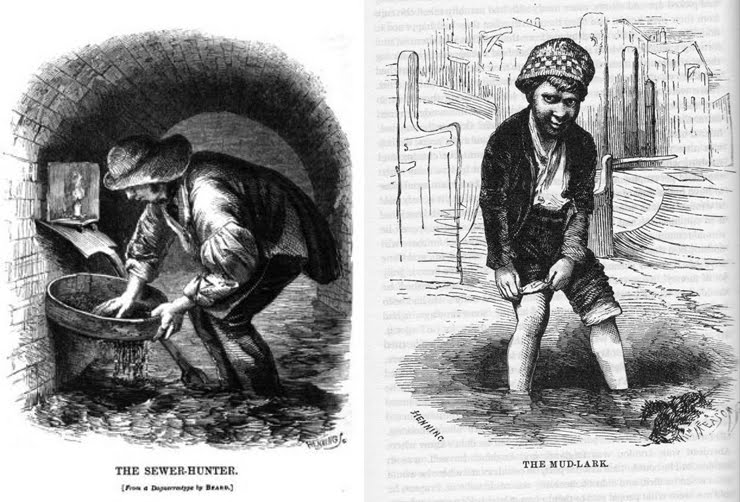
Mudlark: the word was late 18th century slang both for a pig, and for one of the scavengers working the banks of the Thames. Human mudlarks would root around along the foreshore of the river during low tide, searching for lumps of coal, bits of old iron and other detritus that fell from ships — anything which they could sell for a few pence. They were Dickensian characters—but were vividly captured from life by Henry Mayhew, a pioneering social journalist in London Labour and the London Poor (1851). The children (mudlarks were usually under fifteen, but old women would troll the shore as well):
....[were] scarcely half covered by the tattered indescribable things that serve them for clothing; their bodies are grimed with the foul soil of the river, and their torn garments stiffened up like boards with dirt of every possible description.
Today, London's Society of Thames Mudlarks comprises about 60 people in overalls, gloves, and rubber boots who have official permits (browsing along the shore is fine for anyone, but digging needs a permit) to comb the river foreshore with metal detectors.* In Thames, the Biography, Peter Ackroyd lists some of the items the river has yielded to chance and modern mudlarks:
A cup of Trojan origin was found by two dredgermen at Barn Elms, a Greek rhyton of the second century BC was found at Billingsgate...24 Viking swords have been retrieved from the Thames... in one small area just east of Blackfriars Bridge, some 250 medieval pewter pilgrim badges were discovered. In 1834 a bronze head of the emperor Hadrian was found near London Bridge.
       The Thames seems to contain the debris of the world—bird cages and urethral syringes, watches and wooden stools, pipes and phials and wig curlers...A flint hand axe might share the same stretch of river bed with a sixteenth-century pot and a nineteenth century bicycle wheel... In the ancient river all time is redeemable, past and present suspended together in intimate association.... the river is a great depository of past lives.
Ackroyd's meandering story of one of the world's famous rivers is a dreamily evocative and anecdotal sweep of history. He calls the river "a reliquary"—a container or shrine— and it is, not only in the metaphorical sense. The Thames's thick, viscous mud is low in oxygen and as a result, organic decay is greatly minimized. Metal objects retrieved from the depths look, after a swift polish, about as they did when they were dropped in. 
Somewhere there are still blackened remnants of the Great Fire or a commemorative token that slipped out of a hand during a Frost Fair (one of several times the Thames froze over and tents with food and drink, and games of archery and bear-baiting were set up on the ice). I could happily spend my time looking for those... The web site for the Mudlark Society breaks this poetic reverie just a bit. There is no romanticism on these fluorescent green pages. The site revels in fart humor, abounds in misspellings and is one of the ugliest I've ever come across. And yet... there is a fantastic array of documented finds to pore over and the chief mudlark, Steve Brooker, seems like a pretty fun guy. I intend to sign up to go mudlarking on my next trip to London.


Thames Frost, Abraham Hondius, 1677


view from Isle of Dogs, Lorna Richardson, Thames Discovery Programme
 . . . . .
If I would drink water, I must ... swallow that which comes from the river Thames, impregnated with all the filth of London and Westminster. Human excrement is the least offensive part of the concrete, which is composed of all the drugs, minerals, and poisons used in mechanics and manufactures, enriched with the putrefying carcasses of beasts and men, and mixed with the scourings of all the washtubs, kennels, and common sewers within the bills of mortality.
 –The Expedition of Humphry Clinker, Tobias Smollett, 1771
 . . . . .
Mudlark finds, including medieval shoe soles and a coin bearing the image of Faustina Augusta who was briefly empress of Rome in 221 AD. These six preceding images from Thames and Field Metal Detecting Society
*Forget shopkeepers, Britain seems to be a nation of amateur metal "detectorists". Take, for instance, Terry Herbert who in July '09 uncovered a tremendous cache of Saxon gold just below the surface of a cultivated field in south Staffordshire.